Cladding and building safety information
Cladding at Canary Riverside
The complexity of cladding/building safety remediation is laid bare in the FTT’s decision dated 6th January 2026 concerning identifying ‘relevant defects’ at Canary Riverside per s.120 of the Building Safety Act 2022. Their decision, found here, determined that there are six ‘external wall types’ (EWT) at Canary Riverside that are relevant defects under the BSA. This does not mean that all six defects will require remediating, in full or in part. That question is still to be determined by the FTT (hearing date as yet unknown). It’s also important to note that the defects identified do not solely relate to cladding but to building safety defects, eg, including things like missing cavity barriers.
The FTT’s decision refers to seven different External Wall Types (“EWT”). Their numbering does not always match that used in the various cladding reports and we have sought to match the different types using photos extracted from the various cladding reports to help residents identify the different wall types when looking at their building.
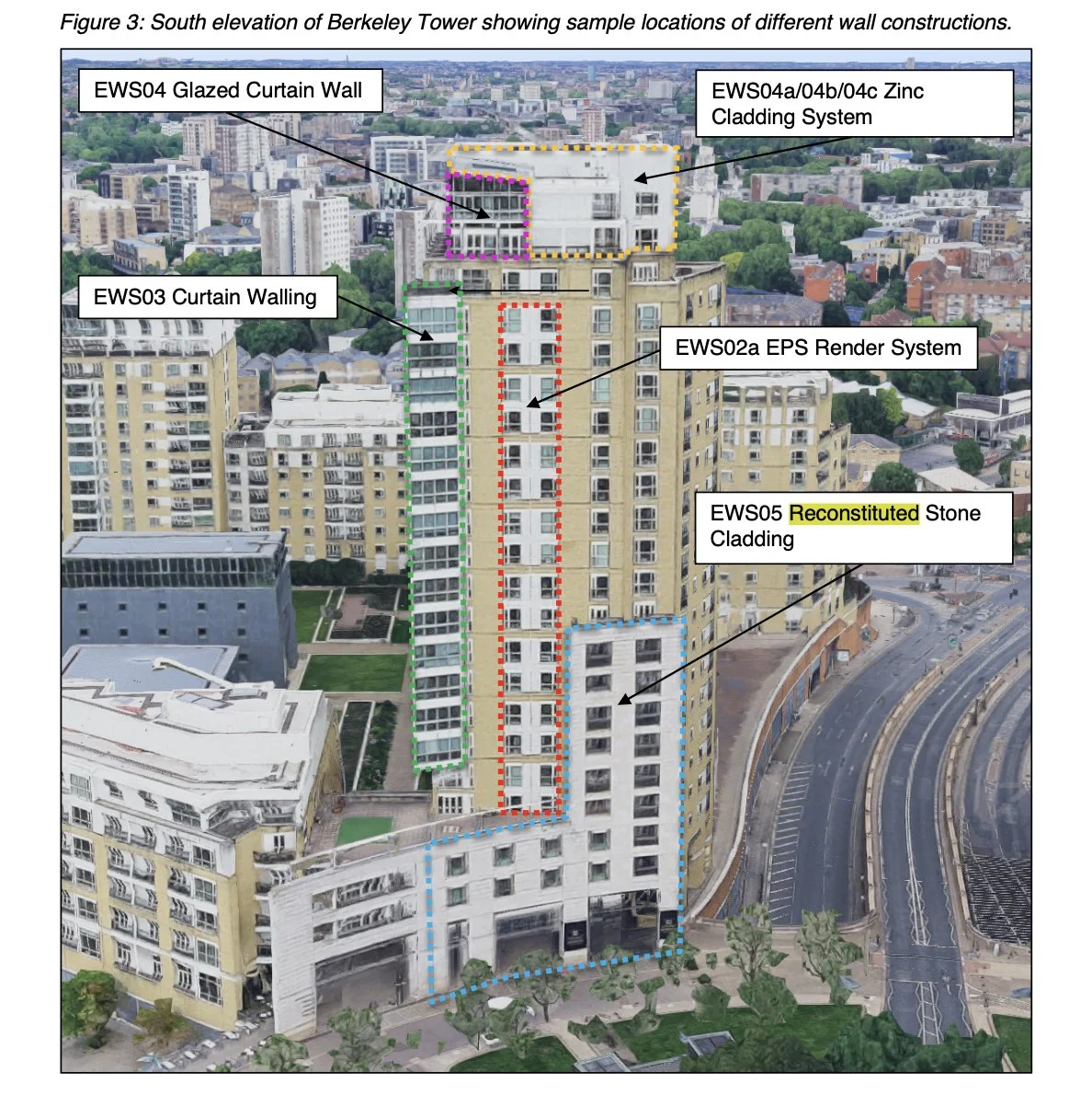
‘Figure 3’ below illustrates the following cladding types, per the FTT’s labelling:
EWT 01: masonry cavity wall. Not labelled in Fig.3 this is the orange brickwork that is the majority EWT used at Canary Riverside.
EWT 02: zinc cladding, labelled in Fig.3 as ‘EWS04a…’ (yellow dotted area).This is primarily found on the penthouse flats.
EWT 03: EPS render on concrete block, labelled as EWS02a in Fig.3 (red dotted area).
EWT 04: EPS render on plywood. Not identified in Fig.3 but found in areas labeled EWS04s/04b/04c (yellow dotted area).
EWT 05: curtain wall and spandrel panels, labelled in Fig.3 as EWS03 curtain walling (green dotted area) and EWS04 glazed curtain wall (pink dotted area).
EWT 07: reconstituted stone cladding, labelled in Fig.3 as EWS05 (blue dotted area).
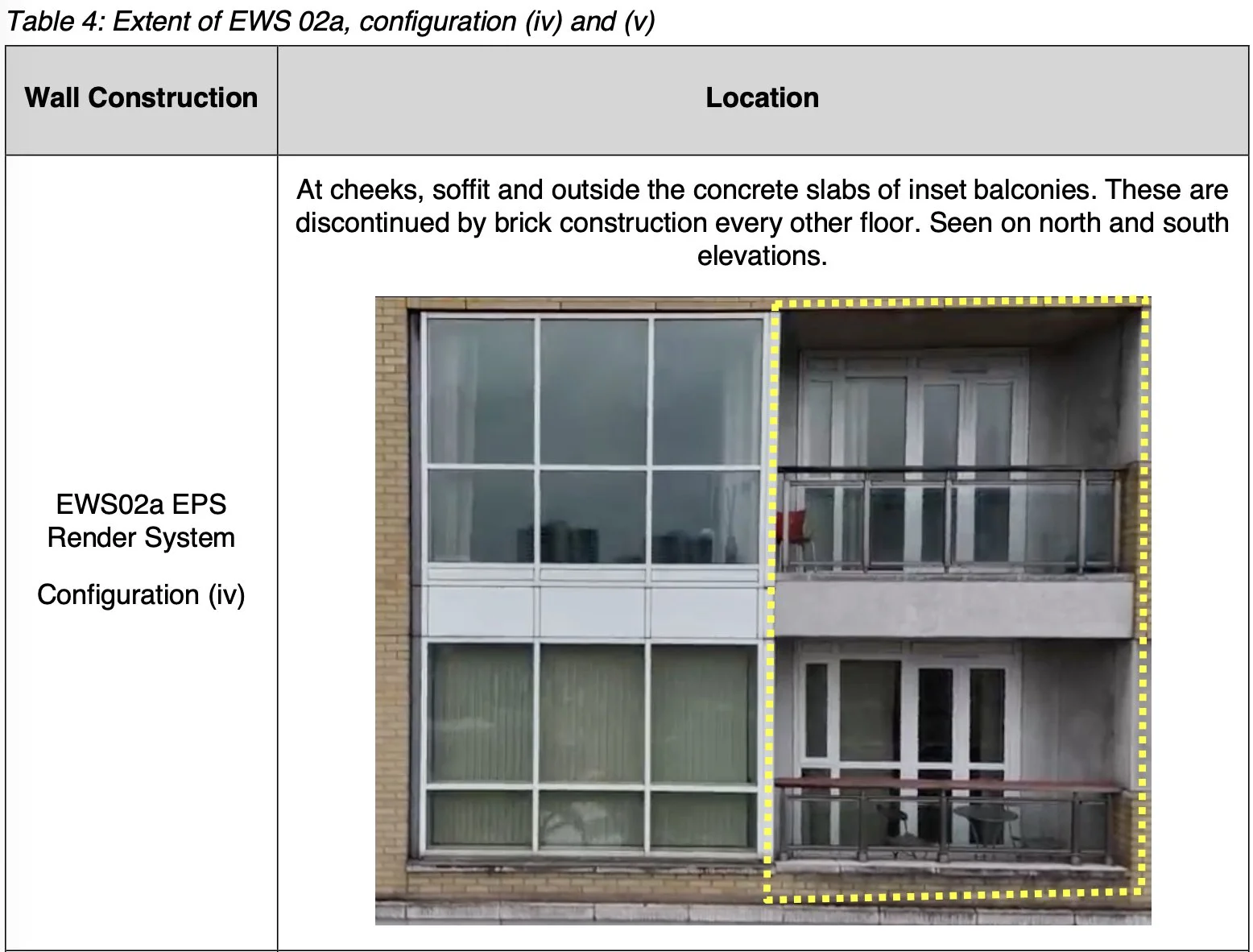
‘Table 4’ below illustrates the location of EWT 06: EPS render on blockwork on balconies (yellow dotted area).
The reason the FTT is considering this matter is because the Secretary of State (MHCLG) has brought a Remediation Contribution Order (RCO) application against our Landlord (CREM/Octagon/Yianis), which, if successful, would require the Landlord to contribute in full or in part to the costs of the cladding remediation required at Canary Riverside. More information on what an RCO is can be found here on the Leasehold Advisory Service website.
Unhelpfully, the underlying building safety regulations have been subject to amendment by the Government, most recently with the withdrawal of the ‘Consolidated Advice Note’ (which underpinned Mr Unsdorfer’s original application to the Building Safety Fund). Its replacement, PAS 9980, is due to be amended again later this year following a consultation. As this BBC article details, applying PAS 9980 is open to subjective interpretation (ie, the identification of ‘tolerable risks’ will vary between individual fire engineers). The End Our Cladding Scandal’s concerns regarding the application of PAS 9980 are outlined here.
The best place for information and news on the cladding and building safety issue can be found at:
The End Our Cladding Scandal organisation - website here
The Leasehold Knowledge Partnership (LKP) - website here.
The National Leasehold Campaign (NLC) - website here.
The issue is frequently mentioned in the media and press: the best way to find the most current information is to do a Google search and use the Tools function to limit your search to the past month.
The official inquiry into the Grenfell Tower disaster concluded last Autumn and the final report and recommendations are awaited. The BBC produced a weekly podcast summarising the week’s evidence, episodes can be found here. The inquiry looked at issues such as the role of firefighting lifts and smoke ventilation systems.